
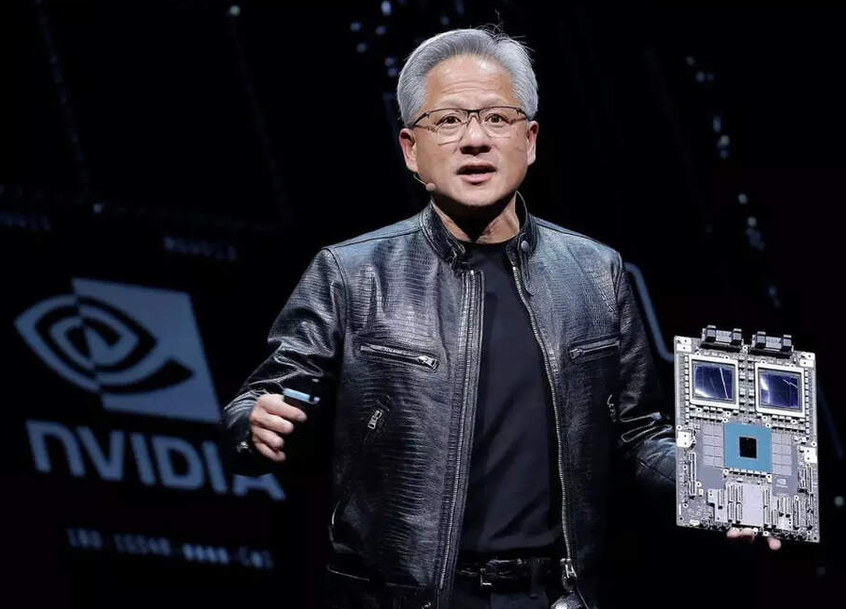
 AMONG the population of modern-day robber barons holding the entire world in their damp-palmed iron grip, NVIDIA CEO Jensen Huang is probably the worst. He epitomizes the maladjusted worldview of the tech titans, which is completely detached from any understanding of human existence or interaction, their faux celebrity, and their utter lack of comprehension of how inevitably disastrous their business models are. When the AI apocalypse happens, although every one of them will have played a part in bringing it on, more of the blame will rightly fall on Jensen Huang than anyone else.
To fully understand why this is so, let’s start with the seemingly banal and move on to the more frighteningly sublime.
First of all, there’s that stupid-looking leather jacket that Huang has adopted as his “signature” look. Apparently, it’s a pretty expensive Tom Ford design that runs $9,000 or so off the rack, and he has several of them. That part isn’t the problem; I’m not particularly impressed with Tom Ford stuff and it doesn’t look like a $9,000 jacket to me, but whatever. The problem is the turd-polishing the jacket represents. I’ve read somewhere that Huang has explained his constant wearing of it as a way – tee hee – to avoid having to think about his daily wardrobe, which is a lame-ass trope ripped off from the 1986 movie remake of “The Fly,” so that he can more fully apply his awesome brain power to using computer technology to participate in the most obnoxious accumulation of wealth in human history.
There are few guys that can pull off the leather jacket look, and even then not all the time; a guy who looks like an associate pastor at one of those annoying Asian “prosperity gospel” evangelical churches (there are a lot of those here in the Philippines) with a name like “Fellowship of Plenty,” or “Millennials for Christ” is not one of them.
In short, in his effort to not look like the dork he probably actually is in real life (most of the stereotypes about computer people are true), his adopted and uncomfortably worn style simply reminds everyone who sees him that he is, in fact, a dork. I blame the late Apple founder (and universally acknowledged Horrible Person) Steve Jobs for this, who started the “celebrity tech bro” trend with his “signature look” of black turtlenecks.
Jensen Huang is not the only one, of course; Amazon founder Jeff Bozos has gone with the Dr. Evil vibe, even marrying a hideous-looking silicon doll to complete the look (The former Lauren Sanchez actually used to be pretty. Bezos’ ex-wife, the reclusive philanthropist Mackenzie Scott, still is.). Meta chairman and Facebook founder Mark Zuckerberg goes with the “frat-boy casual look” most of the time, which simply makes him look like the sort of misfit who would start a college message board to perv on women who wouldn’t go out with him. Oh, wait. That’s exactly what he did. Anthropic CEO Dario Amodei, or Asmodeus, or whatever his name is, carefully cultivates the look of a proprietor of an electronics or furniture store (take your pick) in Passaic that has a “Going Out of Business Sale” sign permanently mounted on the front of the building, and runs a loan-sharking operation out of the back office. Elon Musk, the CEO of “xAI” or whatever the hell he’s calling his basket of weird businesses these days, looks like the personification of colon cancer. OpenAI CEO Sam Altman, who shouldn’t be made fun of for the unfortunate quirk of genetics that made his eyes too close together, ruins whatever slack others might give him by otherwise looking and acting like what a computer program thinks a human being should look and act like.
Although there is stiff competition, Jensen Huang still leads this pack, due to the particular position he occupies at the center of the vast, weird tech ecosystem, which I’ll get to in a moment. In no other industry on Earth is there a “celebrity CEO” component like there is in the tech industry, and this has to stop. The personal adulation that we so willingly give these clowns – which is partly the result of careful image management on their part, utilizing entire teams of people for the task – is a distraction, and gives them cover to do things that no normal business would be permitted to do. If our attention is directed to what the likes of Jensen Huang, or Mark Zuckerberg, or Sam Altman says or does individually, what NVIDIA or Meta or OpenAI does as powerful and capable organizations escapes our notice.
Linchpin of the impending disaster
The reason NVIDIA’s Jensen Huang is deserving of a special level of vituperation is the central role NVIDIA plays in the AI “circle jerk” economy. The following graphic is a bit dated, being published by Bloomberg last year, but even though the specific monetary figures may have changed to some extent, the framework is still the same:
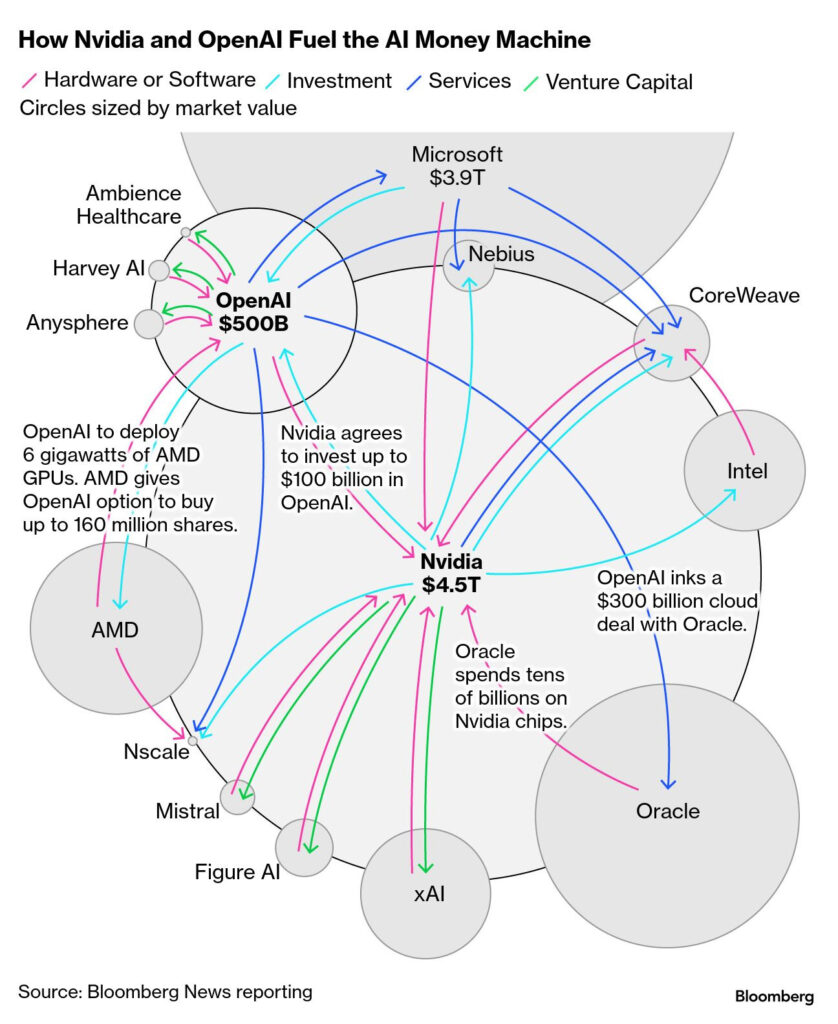
Here’s a simplified explanation. NVIDIA has the corner on the market for the chips and processing units the AI companies need to develop their AI engines. Thus, what happens is that NVIDIA directly or indirectly invests in these companies, which in turn purchase the hardware they need from NVIDIA. As a result, there is no real revenue being earned by any of these companies, including NVIDIA; money is simply circulating around a closed-loop system. In order to make it sustainable, positive revenue has to come from outside this circle – customers who buy the products being created by the AI companies – but so far, those revenues have been a pittance compared to the amounts of money being shifted around. At some point, the whole system will fail, because the lack of uptake by customers of AI firms will cause them to slow or stop the purchase of chips and GPUs from NVIDIA, which in turn will cut down the amount of money NVIDIA can distribute to keep the ecosystem alive.
This is the exact same thing that happened during the “Dot-Com Boom” of the late 1990s, a bubble that spectacularly burst in about the year 2000. AI fanboys will insist until they’re blue in the face that “it’s not the same,” but in listening to these protests, I’ve come to the shocking realization that very few of those who make it were actually around for the collapse of the Dot-Com bubble. This is partly why Jensen Huang deserves a special level of enmity, because he is an exception. Jensen Huang should know better, because he was around for the collapse of the Dot-Com bubble; NVIDIA almost got swept up in it, but Huang – at the time, just a couple of years out of graduate school at Stanford – kept it together. His insistence on doing exactly the same thing now, despite the benefit of experience, is infuriating.
You are meant to be stupid
As a counterpoint to the recent “alarm” spread by key AI leaders (see my previous post), which I have come to the firm conclusion was simply a marketing exercise on their part, Jensen Huang has recently made a couple of completely bonkers statements emphasizing the benign nature of AI. In one recent interview with Al Jazeera, Huang downplayed concerns that have led to a growing community backlash against the construction of AI data centers. The huge amount of capital flowing into “AI factories” (by which he meant the vast amounts being moved around by NVIDIA in the AI closed money loop) “provide the market momentum necessary to modernize aging power grids and scale up sustainable energy,” such as solar and nuclear power, ultimately making electricity cheaper for everyone. In the same interview, Huang similarly pooh-poohed concerns about AI data centers depleting local water resources as “a myth,” arguing that they are moving away from evaporative cooling systems in favor of closed-loop, recirculating hot-water designs that require little fresh water compared to older systems.
That all would be reassuring if any of it was true, but it is certainly not. AI companies are not investing in generation or transmission build-out – NVIDIA definitely is not – because there is no incentive for them to do so, and in fact, the still-tenuous future of their business makes it prudent for them to not invest in broader infrastructure that may be of no use to them within a few months or years. And in places where they have had no other choice but to invest in some energy infrastructure, they have opted for the fastest-to-deploy options with the lowest upfront costs; xAI’s huge data center in Memphis, Tennessee, for example, is powered by 30 large gas turbines. Likewise, even though AI data centers could deploy cooling systems that use less fresh water, they do not, because that is the more expensive and time-consuming option.
Huang’s views on those things are understandable, because anything other than “AI companies should build as many data centers as possible” would be bad for his company’s core business. But in another interview with The New York Times at about the same time as his interview with Al Jazeera, Huang opined that people are stupid for worrying about having “useless” skills, such as knowing how to do basic math. Asked about a recent study of some 26,000 Chinese students that showed AI use improved homework scores and cut completion times, but resulted in much worse long-term information retention and poor exam scores, Huang shrugged it off. “Does it matter?” he said. “I don’t think it does.”
He went on to explain that such ordinary information need not be stored in human brains, thanks to AI, divulging that even he has not bothered to memorize his own home postal code, address, or phone number, because AI can provide that information for him. The message is clear, and horrifying: It is okay for humans to be stupid on a very basic level, because AI will make up the difference. For a price, of course.
What is really discouraging about this, especially coming from someone who is as objectively intelligent as Jensen Huang, is the lack of understanding that, in spite of the AI boosters’ desperate wish to anthropomorphize the technology and treat it as an entity of its own, it requires the creative and intellectual output of thinking humans to form its “intelligence.” The raw information that AI “scrapes” to “train” itself is the product of centuries of human thought; take that away, and AI will progressively become dumber, because what it will be “scraping” will increasingly be made up of other AI-generated information. It is already happening, and it has a name: “AI inbreeding.” Thus, if humans rely on this constantly-degrading body of knowledge, their intelligence will degrade as well. And that is apparently okay, according to people like Jensen Huang.
If I ever meet him, and given the kind of work that I do there is a small but non-zero chance of that actually happening, I want to dump red nail polish on that stupid leather jacket of his. Good luck cleaning that up, nerd.