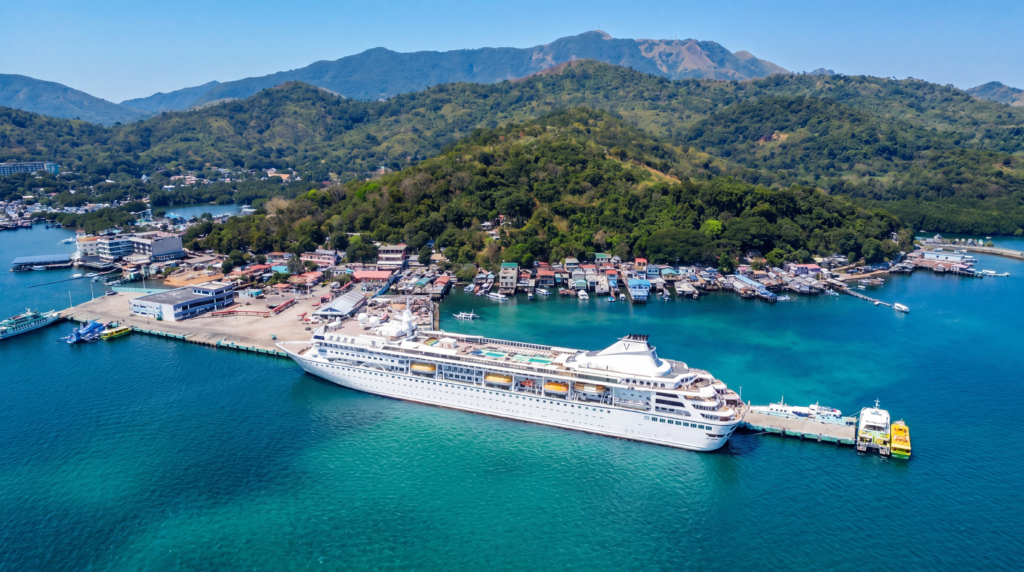
AMONG the usual fare of doom and gloom in the news feed this week was the story of the “residential cruise ship” Villa Vie Odyssey, whose owners unceremoniously told its 200 or so occupants – the majority American retirees – to pack up and get off the boat when it made port in Sihanoukville, Cambodia on Tuesday, Oct. 27 as the company had run out of money for its journey to continue. In a press release, Florida-based Villa Vie Residences blamed soaring fuel costs for the suspension of its operations, initially announcing that it would be pausing for 60 days “while we work toward restructuring and recapitalization.” The following day, the company’s founder, Mike Petterson, told CBS News that Villa Vie would file for Chapter 11 bankruptcy, implying that the “restructuring and recapitalization” was not working out.
The reaction of most people online was “oh, those poor people, what a shame that they had their dreams crushed and just got dumped out of their homes.” My reaction was a little closer to this:

It is frankly mind-boggling how anyone thought this was going to be sustainable. The idea behind the “residential cruise” was that passengers/tenants could purchase cabin space in a setup similar to buying a condominium. Cabins cost from $120,000 up to about $500,000, depending on their size and layout, and the purchase was good for the life of the ship. Then, monthly service charges ranging from $3,500 per person in the lower-cost inside cabins up to about $8,000 for the nicer accommodations were added, which covered the costs of meals, housekeeping, WiFi access, onboard and some offboard activities, and ship operating costs. Villa Vie also offered some alternative plans, such as monthly, no-ownership cabin rental, a five-year plan beginning at about $60,000 plus monthly fees, and a deal for qualifying senior citizens in which they could make a one-time “lifetime” monthly service payment and avoid the recurring bills, beginning at about $100,000.
In exchange for this rather expensive outlay, ship residents could enjoy cutting loose from the tedium of living on land under obnoxious governments (An Oct. 31 article in The Guardian claimed that “getting away from Donald Trump” was part of the sales pitch to Americans, but there is no other evidence of that actually being the case, appealing as it would certainly sound to some people.), and get to visit an endless list of exotic locations. In its promotional materials, Villa Vie advertised “141 countries and 425+ destinations,” which seems rather ambitious, although the ship did make it about ¾ of the way around the world before grinding to an unceremonious halt.
Math ain’t mathing
The aforementioned CBS News report cited company internal documents that indicated that even at full capacity, the ship would only generate $2.5 million in revenue monthly against average monthly costs of $3.1 million. Villa Vie disputed this report, but the fact that the MV Odyssey is now laid up in Cambodia and at risk of being seized by creditors unless Villa Vie can put its Chapter 11 filing through quickly tends to belie the company’s claim that it was ever a going concern.
By the time the MV Odyssey landed in Cambodia, it was far from being at full capacity. Figures given in various news reports indicate that 139 of its 490 cabins remained unsold, and a significant number of those that were sold had been bought by existing residents, under a program the company launched to try to raise money. The ship had a capacity of close to 1,000 people; only 203 (not counting the crew) were evicted in Cambodia, so the “endless cruise” concept seems to have been a far harder sell than its backers are letting on.
According to The Guardian and CBS News reports, there were already signs of trouble months ago, and the outbreak of the US-Zionist war against Iran had been perceived by most of those onboard as a harbinger of doom. The MV Odyssey was here in the Philippines in July of this year, stopping first in Manila (I actually saw it docked at the South Harbor), and then in the resort destination of Coron, but then after that things really started to unravel.
At a subsequent stop in Singapore, the captain had to call an emergency meeting of the residents to raise funds to pay for fuel; apparently, a $400,000 bill was paid through one resident’s personal checking account in order to ensure the ship could leave port. In Vietnam, the contracted food supplier refused to deliver to the ship due to an outstanding bill of close to $200,000, which sent the crew scrambling through local shops to gather supplies, again using money collected through another round of pass-the-hat among the residents; CBS News reported that the crew subsequently had to bribe the Vietnamese port inspectors to allow the supplies to be put on board. And in Hong Kong, the ship was actually detained for a period of time, until money could be raised to pay an overdue bill of some $164,000 to a fuel supplier.
Maybe not strong material
The ship itself has a bit of a dubious history, and certainly is not one built for economical operation. The MV Odyssey was built in Greece in 1993 as a holiday cruiser originally christened Crown Dynasty for a company called Crown Cruise Line, which eventually went tits-up in 2001. The Crown Dynasty was sold to the Norway-based Majesty Cruise Line in 1997 and renamed Crown Majesty; later that same year, Majesty Cruise Line was assimilated by Norwegian Cruise Lines, which renamed the ship Norwegian Majesty.
In 2001, the ship was sold again to the Norwegian-owned but UK-based cruise line Fred Olsen, and renamed again as the Braemar. It stayed with Fred Olsen for almost 20 years, and in 2008 was put into drydock for a major refit, which included the addition of a 31-meter section of hull to increase its capacity.
In March 2020, the Braemar was operating in the Caribbean when officials in Cartagena, Colombia announced that a passenger from the ship that had disembarked during its call there had tested positive for Covid-19. The following day, two additional passengers from the ship who were infected turned up in Alberta, Canada, and four days later when the ship tried to dock in the Bahamas, it was refused because five additional passengers tested positive for Covid-19. After also being denied entry to the port of Sint Maarten, the ship was finally allowed to dock in Havana, Cuba, where the Cuban authorities graciously attended to the care of the Covid-19 stricken passengers – at that point, numbering nearly 20, some of whom later died – and made arrangements to evacuate the rest back to the UK. The Braemar then sat in Havana Harbor for two years until 2022, when Fred Olsen Cruise Lines finally gave up on it and put it up for sale; it was sold to the Villa Vie startup in 2023, and handed over in February 2024, whereupon it was sent to the Harland & Wolff shipyard in Belfast, Northern Ireland for a refit into its current “floating condominium” form.
That did not go as smoothly as Villa Vie hoped, as the refit uncovered significant problems with the ship’s rudder and gearbox. Those were eventually figured out, but it delayed the planned launch of the now-rechristened (for the fourth time) MV Villa Vie Odyssey until September 30, 2024. Even then, as what in hindsight may have been a sign of things to come, the ship was temporarily prevented from leaving the port of Belfast “due to a failure to complete what was described as some final pieces of paperwork,” and finally got underway on October 3.
To be fair, the ship – under its various iterations through the years – has not experienced a serious mechanical breakdown or accident, but on the other hand, it is 33 years old, has a lot of time in service, and is equipped with engines (four Wärtsilä 8R32 diesels, which burn processed bunker oil) and mechanical systems that are at least 20 years out of date. Even in peak operating condition, it is not going to be as economical as newer ships, and there will relatively higher expenses for maintenance.
The cruise industry is evil and must be destroyed
The final nail in the coffin for the MV Odyssey, and the concept behind it, is the appalling irresponsibility of the cruise industry in general. Cruise ships are an environmental nightmare, contributing an outsized amount of greenhouse gas (GHG) emissions that are several orders of magnitude larger on a per-passenger-kilometer basis than any other form of transportation. Ocean pollution is also a big issue; with no one to watch what they are doing, cruise ships typically just dump their sewage and gray water in the sea. Apart from that, because they essentially operate – thanks to the “flag of convenience” model (MV Odyssey is registered in the Bahamas, despite its parent company being incorporated in the US) – outside any environmental or safety regulations.
The economic benefit of the cruise industry is almost non-existent as far as host ports are concerned, in spite of tourism ministries (especially here in the Philippines) falling all over themselves to attract cruise ship port calls. Cruise ships can deliver thousands of passengers to a port within a few hours, creating crowding in cities and small island destinations, but despite the apparent influx of customers, they don’t actually spend all that much; their lodging and food is already provided by the ships, so the affected communities get to enjoy the hassle in exchange for the trade-off of low-revenue spending, such as souvenirs and maybe a few meals.
Since they are able to operate outside most national regulations, cruise lines are also notorious for labor exploitation. Allegations of poor pay, poor working conditions, and even darker issues such as sexual assaults are rife within the cruise industry. To be fair to Ville Vie, there is no record of these kind of complaints, but on the other hand, it has emerged in the exposure of its current financial problems that the crew of the MV Odyssey has not received their pay for several months.
I suppose this is where my inclination to mock the “poor passengers” of the MV Odyssey come from. You all have spent hundreds of thousands of dollars to live in a manner that is ethically, socially, and environmentally exploitative and irresponsible. You are parasites, to put it bluntly. And you’re stupid, because you did not do proper due diligence about the facilities or the company or the economic model you were surrendering to when you sold your homes and cashed in all your assets to live a “dream life at sea.” But hey, Cambodia’s actually an interesting place, may as well look around and enjoy it while you try to figure out how to recover from your sunset-years bad decisions.