
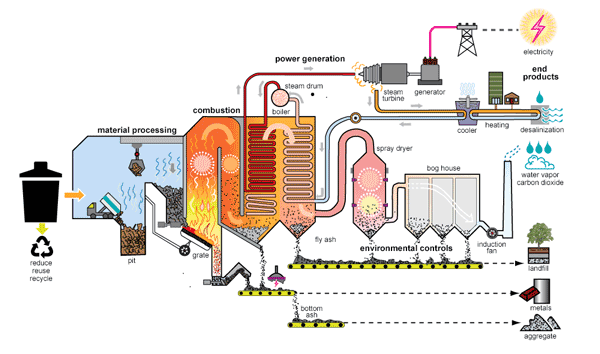
WASTE-TO-ENERGY (WTE) is not literally “bogus” technology, in that it exists and is fairly widely used in developed countries. What is bogus about it is the way it is grossly oversold as an energy solution, particularly in developing countries like the Philippines.
I have written several columns and at least one editorial about WTE here in the Philippines, and it remains a live subject because this country’s Department of Energy is aggressively pursuing its development. The topic came up again recently when a friend of mine (a former chairperson of the Energy Regulatory Commission and National Renewable Energy Board) messaged to compliment my latest screed against the DOE’s dumbass WTE initiative. As that foolishness is still ongoing, I will undoubtedly be writing more about it in the coming weeks; in light of that, I thought it useful to repost what’s come before.
Some realities of waste-to-energy systems
Rough Trade, The Manila Times
(In three parts, published Aug. 14, 17, and 19, 2025)
AS part of the government’s current “look busy” campaign of frowning and hand-wringing over the sorry state of the country’s flood control infrastructure, President Marcos on Monday mentioned the planned development of a waste-to-energy (WTE) facility to be built on the old Smokey Mountain dumpsite in Tondo, Manila as part of a solution to trash clogging drainage systems and waterways. To the president’s credit, he didn’t oversell the notion, explaining that the plan was to build this one, see how well it works, and if the results are positive, duplicate it in other places. And, sensible guy that he is, he added the important caveat that no matter how well WTE may work, cities and municipalities desperately need to get their acts together in terms of managing solid waste.
WTE systems have become popular over the past decade or so, being pitched as a sustainability tool that addresses both the need for municipal waste management and transitioning to clean energy. There are hundreds of WTE facilities across Europe, where the technology has become most developed, and they are being built in increasing numbers in other places. The proposed WTE plant in Manila would be the Philippines’ largest such facility, with an estimated cost of P26.65 billion ($470 million), and a planned generation capacity of 99.37 megawatts (MW), according to documents filed by the project proponent to the Department of Environment and Natural Resources (DENR) in February this year.
It should come as no surprise, however, that not everyone is a fan of WTE; the concept has sparked a great deal of controversy and dissent, because it does have some rather obvious problems. Incinerating trash creates harmful emissions, both greenhouse gases (GHG) and other toxic gases, particularly if plastic and other hazardous materials are mixed in with the waste feedstock. Similarly, the solid waste the process creates in the form of ash and slag can contain toxic substances that can leach into the soil and groundwater. The need to have a steady supply of feedstock works against recycling and other waste reduction efforts; in order to keep the plant running, waste almost always needs to be imported, whether that comes from neighboring cities and towns or from other countries. It is thus extremely challenging to make a WTE plant a financially viable venture, to say nothing of being actually profitable, which discourages investment and improvements to the technology.
I can thank the Covid-19 pandemic for my having gained a great deal of knowledge about WTE systems, because during the lockdowns, when many of us turned to various means of self-improvement to pass the time, I took an online certificate course in public utilities regulation from the University of Turin, which means I can tell people I went to school in Italy, in a manner of speaking. One of the big components of that course was a case study about a WTE system for a hypothetical small city; the pass-fail benchmark was whether or not we could make it work on paper for a period of at least 10 years.
I passed, but it was a wickedly difficult challenge; I went through six failed scenarios before I developed one that worked, and it would be fair to say that one was less than ideal from an economic and sustainability standpoint. It required importing a great deal of waste from other places, creating a few variances to existing emissions and environmental regulations, and subsidizing the electricity that was produced, because the rates that had to be charged for it were otherwise uncompetitively high.
Of course, that was a hypothetical case in an academic exercise, so it may or may not fairly represent a real-world application, such as the proposed WTE facility in Manila. But some of the same kind of analysis can be applied, at least for the purposes of demystifying WTE: Clarifying what it is and is not, how it works, how to avoid some of the common pitfalls of it, and what outcomes could be reasonably expected from it.
A disclaimer is necessary, because there are many details about the proposed facility that have not been disclosed yet, and need to be assumed. What has been shared so far is that the project will be a joint venture, called the Manila Integrated Environment Corp. (MIEC), between Philippines Ecology Systems Corp. (PhilEco) and Japan’s Kanadevia Corp.; PhilEco is the majority partner, while Kanadevia will do most of the heavy lifting in terms of supplying the technology and investment. As mentioned earlier, the plant will be located on the old Smokey Mountain dumpsite in Tondo, and has a designed generation capacity of 99.37 MW, of which 86.95 MW will be available for export to the grid, the remainder being needed to operate the plant. The WTE plant will have a capacity of 3,000 tons per day of residual municipal solid waste, i.e., non-compostable and non-recyclable solid waste. The estimated cost to build the plant is P26.648 billion, or about $470 million.
Other technical specifications of the plant have not been disclosed, and they actually may not have been fully worked out yet, so we’ll have to make some basic assumptions here. Assuming that the developers are properly sensitive to environmental concerns, the plant will likely be of the most advanced available type, with burn temperatures in excess of 1,000 degrees C to eliminate most toxic gases such as dioxins and furans. We will also assume that the plant is equipped with adequate emissions-scrubbing systems to eliminate other dangerous substances, although it probably won’t have, due to high costs, carbon dioxide (CO2) removal capabilities, at least not initially.
With this basic information, as well as statistics on the amount of waste generated by the city of Manila and other potential sources, it is possible to work out a prognosis for the proposed WTE facility. The analysis will necessarily be a bit simplified due to space considerations, but it should be enough to draw a conclusion about whether or not this is actually a good idea.
***
(Second of three parts.)
AS I said in the first part of this column on Thursday (Aug. 14), in order to make a simplified analysis of the practicality of the planned waste-to-energy (WTE) plant for Manila, a few assumptions need to be made. One of the biggest ones, and the one that I am probably personally most uncomfortable with is the necessity, for now, to set aside the environmental factors. A WTE facility, under the best of circumstances, will produce greenhouse gas (GHG) emissions, an average of about 225 kilograms of solid waste in the form of ash and slag for every metric ton of waste feedstock burned, some quantity of wastewater from its operations, and of course, there will be Scope 2 GHG emissions from transporting waste to and from the facility.
All of these things will have to be counteracted or mitigated as much as possible, and there will be considerable costs to that. However, at this point those are almost impossible to estimate with any degree of reliability, so we’ll have to bypass them for now. It may turn out, once a sufficient amount of information is available – which might actually take as long as building the plant and running it to see what happens – that the environmental costs make the whole endeavor unjustifiable, even if the plant is otherwise financially viable. Or the environmental costs may be manageable after all; it could go either way. I’m just making this important disclaimer up front to calm the energetic resistance to WTE and waste incineration; your views are not irrelevant and should be heard, but wait your turn.
The basic question we need to answer before we get to the environmental issues is, can the plant be operated profitably, such that its costs can be recovered within its expected lifespan? The word “profitably” is probably unsettling to some people, but it is the correct word. The plant will need to generate more revenue than its cost inputs; inflation alone over time means that in order to simply “break even,” the plant will still need to generate a profit margin of at least a few percent.
For this plant, because we’re simplifying things and already need to make more assumptions than is ideal, the cost factors to be considered are the cost of construction; the cost of operation and maintenance; and depreciation. The costs we are leaving out are the cost of financing, exchange rates, and what is termed the “learning rate,” which is a factor applied to first costs for a new plant. I had actually intended to include the latter, but the sources I consulted were all over the place with their estimates, so to avoid complications we’ll just disregard it.
The construction cost of the WTE plant, with an announced capacity of 99.37 megawatts, is P26.648 billion according to filings with the DENR, which neatly rounds up to $470 million at current exchange rates. That gives a construction cost of $4,730 per kilowatt of installed capacity, which is a bit of a red flag for being such a bargain. As a comparison, a 36-MW WTE plant proposed by Metro Pacific for Quezon City a few years ago had a per-kilowatt cost of $11,750; in my case study in 2022, the best available information at the time suggested an average construction cost of $6,075 per kilowatt of installed capacity.
For comparison, liquified natural gas (LNG) generation has a cost that ranges from about $700/kw to $1,700/kw, depending on the type of plant, while utility-scale solar photovoltaic (PV) is averaging about $620/kw. Thus, even at a suspiciously low construction cost, the cost of the Manila WTE plant is still very high in the context of power plants, approaching the low end of the range for nuclear power. However, if we view the WTE plant as being principally a waste management system rather than an energy production system, the high cost may not be considered such a negative factor.
Operation and maintenance costs can also vary, but if we assume the WTE plant is of what would be considered the standard type, those would be about $0.09 per kilowatt-hour. Those costs would increase each year by roughly the same percentage as the plant’s depreciation rate, but they are also tied to the plant’s capacity factor. Capacity factor is the ratio of the plant’s actual output over a given period of time to the maximum possible output it could have produced if it had run at full power during that same period. Here, a capacity factor of 77 percent is assumed, as that is about the average for existing WTE plants; if the capacity factor is higher (not likely), the operations costs will be higher, but will be reduced if the capacity factor is lower than 77 percent.
Depreciation is another variable that is affected by the plant’s capacity, capacity factor, and level of maintenance, so the best we can do is estimate it based on the performance of existing WTE plants. A WTE plant is a form of thermal power plant, and those generally have a depreciation rate of between 10 percent and 25 percent per year. That is part of what makes thermal plants like coal and gas plants so financially attractive and hard to get rid of, because they depreciate rather quickly but have a reasonably long lifespan, meaning that can they become profitable in a relatively short amount of time. For the purposes of making a conservative estimate, we’ll assume 10 percent, with a design lifespan of 30 years, which is normal for most thermal power plants.
With all of those inputs, the result is that after the plant is built, it will need to recover approximately $47.7 million in costs in its first year, which decreases gradually to about $19 million by year 10. The figure would drop to about $7 million by year 20, and about $3 million by year 30, at which point the plant would be likely need to be retired.
Now that we know what the plant will cost, we need to take a look at what it can earn, and whether or not that will come close to making it at least self-sustaining, and ideally a profitable venture. That will be in the last installment of this column on Tuesday.
***
(Last of three parts.)
IN spite of the large amount of municipal solid waste generated daily in Metro Manila – about 10,368 metric tons, according to the best available data – it may actually be difficult to keep the planned waste-to-energy (WTE) plant in Manila operating at its full capacity of 3,000 metric tons per day. That is because only about 12.47 percent of that waste is residual waste suitable for use as fuel; the biggest part of it (42.8 percent) is biodegradable waste, while about 37 percent is recyclable waste, with the remaining 7.5 percent being hazardous waste. If we make the extremely optimistic assumption that local solid waste management systems are able to properly sort and segregate waste, that means the entire NCR will only be able to provide about 1,293 metric tons of waste feedstock to the WTE plant per day.
At its full 3,000 mt/day capacity the WTE plant will have an estimated capacity factor of only 77 percent, so a reduction in feedstock will result in a corresponding drop in capacity. The usual way to resolve the supply pinch is to import waste; if the residual wastes from Region IV-A and Region III were sent to Manila’s WTE plant, it would have sufficient feedstock. That solution has the downside of eliminating any possibility of building additional WTE plants in nearby regions, as well as adding to Metro Manila’s traffic in a particularly unpleasant way.
For the moment, we’ll assume that the WTE plant will be supplied with its full 3,000 mt/day capacity of residual waste. The plant has an advertised generation capacity of 99.37 megawatts, which actually sounds a bit optimistic, as that suggests it would only require about 30.2 mt per MW. By contrast, a detailed feasibility study carried out on behalf of the MMDA and published in November 2023 under a project funded by the World Bank and Asian Infrastructure Investment Bank (AIIB) came up with a figure of 45.5 mt of waste per MW.
All of these figures point to a difficult to avoid conclusion that the proposed WTE plant in Manila will most likely not produce its hoped-for amount of electricity; instead of 86.95 MW that can be exported to the grid, the more realistic figure is closer to 44.4 MW. That is not an insignificant amount; one hour of operation could power 15-20 average residential customers for a month. But the cost of that electricity, which is already expensive, is going to be nearly double what’s assumed by the initial design.
In order to figure out if this is going to work, we go back to the costs the plant will need to recover over its projected 30-year lifespan, which I summarized in very brief form in the previous installment of this column on Sunday (Aug. 17). If we take those total costs, construction, depreciation, and operations, add a modest return on investment – I’ve made an arbitrary selection of 12.5 percent over the life of the project – and spread that out over a 30-year period, the result is a revenue requirement of $48,815 per day, or P2.74 million per day at current exchange rates.
There are really only two ways a WTE can generate revenue, first from the sale of electricity, and second, from tipping fees, i.e., the charge to local governments for disposing of their solid waste. The MMDA currently charges P257 per cubic meter, which translates to about P1,465 per metric ton, for collecting trash in Metro Manila, but that includes transportation and labor; the actual cost per metric ton at the landfills is about P600. Assuming that the WTE facility matches that, it can generate P1.8 million per day in tipping fees.
The rates for electricity are a little trickier, as they are dependent on a number of factors including the time of day. To keep things simple, we can use Meralco’s average generation cost for August, which is P7.8096 per kilowatt-hour (kWh). Based on the more realistic estimate of the WTE plant’s output discussed earlier, we can forecast 34,188 kWh per day; at P7.8096/kWh, that’s P266,995 in energy sales. That plus the tipping fees equals P2.07 million per day, or about P670,000 short. Stretch that out over an entire year, and it amounts to a loss of a little more than P244.5 million.
It could be possible to make that deficit go away; higher rates for the electricity produced could be charged, either directly or through the application of a feed-in tariff, tipping fees could be increased, and various ways might be found to reduce operating costs. However, the above is already only a reasonably plausible best-case scenario; if either the amount of waste the plant processes or the amount of electricity it exports to the grid fall below those estimates, and it is very likely they would fairly often, the operating losses will be higher.
In the context of the Philippines’ privatized generation sector, the Manila WTE plant is a terrible investment, a complete non-starter. But, if the government were willing to absorb its financial losses through subsidies, is it at least a useful idea for solid waste management?
The answer, unfortunately, is probably not. Its existence may help to improve local-level solid waste collection and segregation habits, but as we all know, that kind of social change takes a great deal of time here. In terms of its actual impact on reducing the volume of solid waste, that would be modest at best; at its full processing capacity, it would reduce the daily volume of waste to landfills by about 8.7 percent. I suppose that is still progress, but whether that accomplishment is fair value for the enormous expense, effort, and environmental risks – which haven’t even been considered in this analysis – of WTE is highly debatable. In my opinion, there must be more sustainable and cost-effective ways to achieve that.
DOE policy on waste-to-energy a recipe for failure
Rough Trade, The Manila Times
(Published Oct. 28, 2025)
ON October 16, the Department of Energy published a draft department circular, as yet unnumbered, setting forth a proposed framework for the integration of waste-to-energy (WTE) into the country’s energy mix. This is a component of the “clean energy scenario” under the Philippine Energy Plan, according to the DOE, which is apparently counting on “because we said it, it must be true” to validate that claim.
Let’s cut to the chase: The proposed policy is a futile attempt to put lipstick on a pig, one that does not so much as acknowledge, let alone address the fundamental problems with WTE. And it would seem that the DOE knows it, because steps were taken to restrict public feedback on the plan. It was posted to the DOE website someday during the day on Thursday, Oct. 16, but those wishing to comment on the draft proposal were only given until Monday, Oct. 20 to do so.
I have broken down the WTE concept at length in the recent past, having devoted an entire weeks’ worth of columns to the subject back in August (“Some realities of waste-to-energy systems,” in three parts on Aug. 14, 17 and 19). This exercise was provoked by the announcement of a planned WTE facility for the City of Manila, and so the analysis was based on the specifications of that particular project. However, the fundamental problems with WTE are common to all such projects, and a policy promulgated by the DOE or anyone else that ignores them is not going to simply make them go away.
The pushback against WTE occurs on two levels, and again, the DOE’s proposed policy does not acknowledge either of them. On the social level, as it were, the two biggest criticisms of WTE are that it is environmentally unfriendly – it can produce a considerable volume of pollutants – and that it works at cross-purposes to waste reduction and recycling policies that are already in place, and actually followed in some places. On the latter complaint, there is no real way around the problem, except in the manner proposed by the specifications of the WTE facility sought by Manila, which is to restrict the waste feedstock to non-recyclable, non-biodegradable municipal waste. That causes entirely new problems, which are explained below. On the environmental worries, WTE technology does exist and is in use in other places that eliminates the greater part of harmful emissions and toxic contamination of solid waste by-products (fly ash) by operating at extremely high temperatures. However, this too causes a number of other problems.
The practical criticism of WTE centers on the almost unworkable economics of the idea. Any WTE facility, and particularly the newer, cleaner versions – the only ones that should be allowed here, but of course the DOE’s proposed policy does not suggest any such standards – have very high upfront costs, considerably higher than different forms of renewable energy, and not far below that of combined-cycle gas generation. Recovering those costs through high rates for the electricity generated, which the DOE proposal implies will be acceptable, is not likely to work because the output of WTE is limited; 100 to 150 megawatts of capacity is about as large as they can be.
The size of the plant is limited primarily by the amount of available waste feedstock; according to a 2023 feasibility study by the World Bank and the Asian Infrastructure Investment Bank on the prospects for WTE here in the Philippines, a typical plant requires approximately 45.5 metric tons of waste per megawatt of capacity. Metro Manila produces between 9,500 and 11,000 metric tons of waste per day, but only about 30 percent of that would be suitable as WTE fuel; this is why the WTE plant proposed for Manila is designed for a 3,000 metric ton per day capacity, and even then it would have to compete with other WTE that might be developed, such as one planned in Quezon City.
So what inevitably will happen is that the planned generating capacity will only be achievable on an intermittent basis, and for very short periods of time at that. Or, in order to ration the fuel supply to keep the plant operating continuously, it would be operated at a much lower level of output. This would almost certainly be the case, because shutting down and starting up a WTE boiler is not a rapid process, taking several hours at least. Thus, we would have a plant providing an inconsequential amount of electricity at extremely high prices. Since the DOE is anxious to have investors build these plants, various provisions in the proposed policy guarantee they will have off-takers, and that saddles us all with higher electricity rates. The irony is, even at that, because of the low production, the operators of the plants would likely still lose money.
DOE’s answer to that might be that the plant operators can generate revenue through tipping fees; instead of paying to take waste to a landfill, cities and municipalities would instead pay the WTE facility. If that is the case, however, then the WTE facility ought not be allowed to sell the electricity, as that would amount to selling the public back its own garbage, in a converted form. I think some lawyers would probably have fun with that one in court.
The only sensible way to handle WTE, if the country is dead-set on making it work, is to treat it strictly as a waste management system. It does that very well, and whatever energy it generates as a byproduct should be treated as such; power to run the facility itself, and perhaps share a bit back to the local distribution grid in a net-metering context. And, if WTE is treated as it should be as waste management, then DOE shouldn’t be handling it.
Of course, sense has never been allowed to get in the way of an attractive idea under the DOE’s current leadership, so there is no reason to think it will now. But when the WTE idea flops like a lead balloon, at least everyone will know why.
Concern and cautious optimism over WTE bill
The Manila Times Editorial, published May 23, 2026
THE House of Representatives on Wednesday night overwhelming approved a bill intended to address the Philippines’ catastrophic solid waste management crisis and reduce pollution that worsens flooding. Despite strong opposition from environmental groups, House Bill (HB) 9157, or the proposed “Waste-to-Energy Act,” passed with a vote of 255 in favor, with only six opposed and three abstentions. The measure still needs to pass the Senate, of course, although there is no reason to believe at this point that it will not; as it was already designated a priority legislative measure by President Ferdinand R. Marcos Jr., it is very likely that the resulting law will take effect sometime before the end of the year.
This development is news that should be viewed with both cautious optimism and some concern. If properly and consistently enforced, the proposed law will be enormously beneficial in reducing solid waste pollution and breaking the country’s reliance on dangerous and environmentally unsound landfills. However, there are some troublesome gaps in the measure, and there are legitimate concerns raised by the bill’s opponents that have not been fully addressed.
As stated in the bill, the overall objective of HB 9157 is to establish a national framework for the development, regulation and operation of facilities utilizing waste-to-energy (WTE) and other waste treatment technologies. The preamble to the bill also emphasizes the goal of reducing flooding caused by solid waste accumulation in waterways, drainage systems, and flood control infrastructure. It also stresses the objective of reducing dependence on open dumpsites, which is no small point, as events in the past few months have demonstrated in tragic terms that the Philippines is quickly approaching a crisis in terms of solid waste management by means of landfills. Cebu’s only useable landfill suffered a catastrophic collapse a few months, leading to the city government declaring a “garbage emergency”; Metro Manila and surrounding areas were afflicted for with dangerous air pollution for a period of time due to the stubborn fire that broke out within the abandoned Navotas landfill last month; and just this week, a landslide at the main landfill serving Davao City tragically resulted in several people being killed.
The aspect of the bill that we find rather alarming is that under the measure, WTE facilities will primarily function as energy production facilities while integrating solid waste management systems consistent with Republic Act 9003 or the Ecological Solid Waste Management Act of 2000. This, we believe, is a mistake. WTE is not primarily an energy solution, it is a solid waste solution. Energy production from WTE facilities should not prioritized, because the stream of waste feeding the facility will, ideally, be reduced over time due to other worthy efforts to reduce solid waste, namely recycling programs, programs to implement “greener” packaging, and other waste-reduction measures. One of the major complaints of environmental groups is that WTE systems, because they require a steady supply of feedstock (i.e., garbage) if the energy production aspect is prioritized, tend to discourage other waste-reduction initiatives.
This is absolutely correct. The measure should be considered primarily as a solid waste management measure, with energy production being considered as a secondary and variable benefit. In fact, the bill, while classifying WTE as primarily an energy solution, sabotages itself by specifically banning the import of waste, whether it comes from sources outside the country, or from distant domestic sources. That ban is absolutely appropriate, but as one of our editors who has specific experience in designing a WTE system has explained, it absolutely eliminates the WTE facility as a reliable source of electricity generation; it can supplement power needs, but only to a modest and intermittent extent.
The other major concern of those opposed to WTE is its environmental risks of waste incineration, which is what WTE actually is, no matter how its proponents may style it otherwise. These are valid concerns, because in order for WTE to work effectively and minimize environmental risk, it must operate with a high degree of technical and management efficiency. There are WTE systems that reduce the waste involved to a minimal, low-impact volume without creating harmful emissions, but having witnessed the poor state of landfill management – the recent calamity in Davao, for example, revealed that just about every regulation pertaining to landfills had been violated – there are legitimate concerns about whether the prescriptions of the new proposed law will be faithfully followed. Thoroughness and attention to detail in setting up the implementing rules and regulations for the new law, and maintaining strict compliance will be key to the success of the initiative.
DOE persists with its WTE fantasy
Rough Trade, The Manila Times
(Published May 28, 2026)
IN a brief news item over the weekend, it was announced that the Energy Regulatory Commission (ERC) has established a green energy auction reserve, or GEAR price for the impending GEA for waste-to-energy (WTE) facilities. The GEAR price is essentially the ceiling price for electricity produced by facilities subject to the auction, and is intended as a guide to prospective bidders so that they can determine whether a project will be economically attractive or not. In this case, the ERC set the GEAR price at P9.2959 per kilowatt-hour (kWh), a price that was actually higher than it originally proposed, but is in the same ballpark with GEAR prices in previous auctions for solar and offshore wind.
There is so much wrong with this entire topic that it is difficult to know where to begin. The problem is not with the ERC; it has no control over whatever hare-brained scheme the DOE decides to launch, but must try to set regulatory parameters for it. The more ludicrous the initiative, the less consumer-sensitive those parameters are going to be; garbage in, garbage out, so to speak. A generation cost of P9.3/kWh results in a bill of about P17.22/kWh for most consumers once transmission, distribution, and other charges are added in. Take a look at your own electric bill (my May bill from Meralco carried a charge of P15.57/kWh, a rate that had customers howling bloody murder) and decide for yourself if that is a reasonable price.
The DOE’s green energy auction program (GEAP) has been deeply flawed from the moment it was launched, but this latest round is beyond ridiculous, even if the obnoxiously high indicative price for the power produced is completely disregarded. The DOE is planning to offer 230 megawatts (MW) of WTE capacity in the auction, to be held sometime in August. Every other round of the GEAP has resulted in less capacity than awarded making it off paper to facilities in operation or under construction, but there is high probability that the amount of WTE capacity that will be built will actually be zero, or some number very close to it.
In a fair and rational world, the phrase “waste-to-energy” would instantly be struck from everyone’s awareness. That is because, and repeat it to yourself as many times as you need to, WTE is not an energy production system, it is a waste management system. That is not simply my crusty opinion, that is the characterization of it by the US Energy Information Agency (EIA). Yes, burning municipal waste can produce electricity, but that is a secondary and rather modest by-product.
The main reason for building a WTE system is to reduce the volume of municipal solid waste (MSW) going to landfills. We have a huge problem with landfills in the Philippines, so WTE might be a worthwhile solution for that reason; but in that case, the Department of Environment and Natural Resources (DENR) should be taking the lead in it, and not the DOE. But we have an energy guy in charge at the DENR and a politician in charge at the DOE, so things work a little differently here.
Math time
A little bit of basic data quickly reveals why WTE won’t work as “green energy” here, especially under the parameters of existing WTE policy, which will be codified in the new WTE law that will almost certainly pass once the Senate stops goofing off and does some real work. Under that policy, only non-compostable and non-recyclable MSW can be used as WTE fuel, and MSW cannot be imported, either from outside the country or from one waste management jurisdiction to another.
That means of the roughly 60,000 metric tons of MSW created daily in the Philippines, only about 18,000 metric tons, or about 30 percent, is usable for WTE. In a mass-burn system, such as is common in the US, the proportion is closer to 85 percent.
To generate 1 MW of electricity, a WTE plant needs to burn between 1 and 1.6 metric tons of MSW per minute. Thus, if the entire usable volume of MSW of the Philippines was burned, the electrical output would be a whopping 0.3 megawatt-hours (mWh) per day.
You will note that 0.3 is quite a bit less than 230. And even if the policy was adjusted to permit the mass-burn systems, bumping the MSW fuel volume up to about 51,000 metric tons per day, that would still only provide about 0.85 mWh per day. For reference, according to DOE data, the Philippines’ daily electricity consumption averages between 305,000 and 320,000 mWh.
Not actually green
So, how would WTE plants provide the expected 230 MW of capacity? Obviously, by burning something else for fuel, most likely gas or oil. All WTE plants have gas or oil burners in them, which are used to start up the unit by bringing the firebox up to the proper temperature where MSW can burn cleanly (between 830 and 1,400 degrees C), and to add extra heat when necessary to keep the unit at those temperatures.
If the priority is waste management, then this is not really a problem. The conventional burners are used sparingly, and do not contribute greatly to undesirable emissions. However, if the priority is energy production, then unless there is a constant and abundant source of MSW fuel – which, as explained above, there isn’t here – what you have is not “waste-to-energy,” but a conventional gas- or oil-fired generator. And one that is most likely of a capacity that is too low to be economically sensible, except in areas isolated from the main grid, or with even less desirable generation sources, such as diesel or bunker oil generators.
I have long suspected, and some of my learned colleagues have the same suspicion, that the GEAP is less an exercise in building a rational, sustainable RE sector than it is a campaign of political window-dressing, like the continual claims of “investment pledges” from trade-related agencies. The utter unreality of the WTE initiative does nothing to assuage those suspicions. As I have said, WTE – or rather, let’s call it what it really is, waste incineration – is an option worth exploring given the Philippines’ critical solid waste management situation. Provided, of course, it can be done safely, and with minimal environmental impact, and done in a way that is complementary to waste-reduction and recycling programs.
***
As an additional note – and this is why I will be aiming another salvo at the DOE in the coming weeks – shortly after the ERC approved the higher than initially estimated GEAR price for the WTE auction, the DOE upped the capacity on offer from 230 MW to 400 MW. The comedy really does write itself, sometimes.