As I mainly focus on energy and climate in my work for The Manila Times, I cover all sorts of different technologies; some through my own curiosity and research, and a considerable number because my email inbox is a gravity well for pitches from organizations looking for publicity. Climate action and the energy transition are fertile grounds for ideas their creators and backers believe are “the next big thing,” and so many of these pitches are for technologies that are, to put it politely, utterly ridiculous. I keep a running list, and in this occasional series I will discuss them in turn.
Let’s fix global warming with farts
 Solar Geoengineering is a class of technologies that (hypothetically) involves reducing the amount of sunlight reaching Earth’s surface, thereby causing the atmosphere to cool; the idea was inspired by the completely natural, and sometimes terrifying effect of massive volcanic eruptions throughout Earth’s history, which lowered temperatures for a period of time. Some examples include the eruption of Tambora in Indonesia in 1815, which caused the famous and deadly “year without a summer” in 1816; the eruption of Krakatoa in 1883, which lowered average temperatures in the Northern Hemisphere by about 0.3℃; and the 1991 eruption of Mt. Pinatubo in the Philippines in 1991, which lowered temperatures by about 0.5℃ for more than a year.
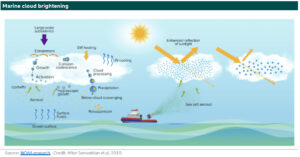
Thus, the idea is if this effect could be artificially created, it could lower global temperatures are forestall the effects of global warming. While there are a number of different models that have been proposed – some of them rather outlandish – the two main technologies that researchers are focusing on are Stratospheric Aerosol Injection (SAI), and Marine Cloud Brightening (MCB). SAI copies the volcanic effect, and entails injecting large amounts of sulfur dioxide (SO2) gas into the stratosphere, where the gas molecules would reflect sunlight back into space. MCB, which is usually described as a more localized technique, involves spray salt vapor into relatively low-lying marine clouds, making them more reflective and longer-lasting.
To be fair to proponents of solar geoengineering, they are consistently clear that the technology is not a solution to the underlying cause of global warming, which is the accumulation of greenhouse gases (GHG) in the atmosphere from human activity. Solar geoengineering is instead pitched as a “first aid” solution, something that could slow or even stop the global warming trend for a period of time, until permanent solutions to eliminate anthropogenic GHG emissions and remove excess carbon dioxide from the atmosphere could be implemented.
Spoiler alert: It won’t work.
Why it’s bogus technology
I’ll address MCB first, because it is the less-ridiculous of the two technologies, even though it is still, well, ridiculous. Spraying saturated salt water spray into low clouds is certainly technically feasible, on a relatively small scale, and is not much different than cloud-seeding. A fleet of boats fitted with spraying equipment (the method usually described) could probably cover an area of several dozen square kilometers, perhaps a bit more, which is why the technique is usually described as suitable for specific targets. For example, it has been proposed as a protection for parts of Australia’s Great Barrier Reef, and has even been tested on very small areas, although with inconclusive results.
(Most of the experiments that indicate these technologies would work are computer models, not actual real-world tests. This is a common theme across all the Bogus Technologies.)
Economically, modest-scale MCB is certainly feasible. It is technically feasible as well, as it does not require any sort of exotic equipment, although it is difficult to scale up to cover very large areas. Where the main flaws of MCB lie are in the risks of altering local weather patterns, and in the relatively short-lived effect it would have.
First of all, cloud-seeding of any kind induces rain, unless the atmosphere is very dry, which it certainly is not over the ocean. That might not necessarily be a bad thing if, for example, the rain remains offshore over a reef area that someone is trying to protect, but could be extremely unwelcome if it moves inland. And, since the material of choice is salt spray, any rain that falls is going to have at least a slightly higher salinity, which could be very bad for crops and fresh water sources. In addition, weather patterns might immediately undo the “salt spraying” efforts; a cloud bank being targeted might move or disappear if the wind shifts or the atmospheric pressure changes.
The biggest knock against MCB, however, is its limited applicability. Even in the implausible scenario where there were tens of thousands of ships (or planes) available to apply the salt spray, it requires existing clouds, which certainly do not exist everywhere all the time.
SAI, on the other hand, is utterly ludicrous, and it is fascinating and a little depressing that so much money and effort continue to be put toward researching it. The University of Chicago even created an entire department for it within its Institute for Climate and Sustainable Growth, which, personally speaking, reduced my opinion of that august institution by a couple of notches. You guys built the first nuclear reactor, you’re one of the best schools in the world for medicine, law, and journalism, but now you’re messing with this nonsense. What the hell is wrong with you.
SAI involves using aircraft to spray SO2 directly into the stratosphere, artificially duplicating the effect of massive volcanic eruptions. There is no part of this idea that makes any rational sense whatsoever.
First, the technical problems. As noted above, the 1991 eruption of Mt. Pinatubo resulted in a 0.5℃ drop in global temperatures (mostly in the Northern Hemisphere) for about 15 months. That was the result of between 15 and 20 million metric tons of SO2 being produced by the volcano. The SO2 has to get into the stratosphere, the layer of the atmosphere between about 12 km (about 39,000 feet) up to about 50 km (164,000 feet), and the higher the better.
The biggest existing cargo plane in the world at the moment is the Antonov An-124, which has a cargo capacity of approximately 150 metric tons, and can just barely reach an altitude of 39,000 feet. So, it would take at least 100,000 planes the size of the An-124 (there are a total of 26 in service now) to deliver enough SO2 to the minimum altitude needed to match the effect of Mt. Pinatubo. And while SO2 lasts for some time in the atmosphere, it does eventually wash out, so that would need to be repeated every year or so, in order to reduce atmospheric temperatures by about 0.5℃.
Then there are the unintended atmospheric effects, which computer models are poor at predicting, something UCLA researchers discovered when studying the 2022 eruption of the Hunga Tunga Hunga Ha’apai volcano in Tonga (On a side note, I like when I have a reason to refer to that volcano, because I like saying the name. Same with Popocatepetl in Mexico.). SO2 reacts badly with the ozone layer; it is not a big problem as long as it stays in the stratosphere, because the stratosphere is dry, but as it descends through the atmosphere (because of a thing called gravity), the reaction between sulfur dioxide and ozone produces sulfuric acid – 3SO2 + O3 + 3H2O –> 3H2SO4. So, while the SO2 reflects the longwave radiation from the sun that causes heating, it destroys the ozone that reflects the ultraviolet radiation. Cooler atmosphere (maybe), but increased risk of skin cancer as a trade-off. As an added bonus, the product of the reaction produces acid rain, which kills plants and sterilizes soil.
There are also geopolitical and regulatory concerns with SAI, which are acknowledged by proponents and critics alike, but the technical impossibility and the severe physical risks of it render those arguments moot, as far as I’m concerned.
So no, solar geoengineering will not work, is a waste of time, and quit sending me emails about it, I’m not going to give you free publicity.