 IN jaw-dropping news on Wednesday (Sept. 2), Enrique Razon-led Prime Infrastructure Capital Inc. (Prime Infra) announced that it had appointed former BP CEO Tony Hayward to its board of directors. Why Prime Infra did this is absolutely baffling to anyone who has been alive for more than 20 years, because Hayward is one of the most infamous figures in the history of the oil and gas industry.
What I found interesting is that none of the news stories, at least those that came out on Wednesday, mentioned why Tony Hayward is infamous, sticking instead to copy-pasting whatever press release was handed out by Prime Infra. It mentions that Hayward is the chairman of Colombia-based SierraCol Energy, a company he founded in 2020 with the backing of the Carlyle Group and which Prime Infra acquired in March of this year. It also mentions that he was chairman of the mining company Glencore from 2013 to 2021, and that he worked with BP since 1982, climbing the ladder to be named its group chief executive in 2007, a post he held until 2010.
Prime Infra undoubtedly would like that to be all the information anyone reads or hears, because that all sounds fairly respectable and normal. Experienced resource industry guy, has worked around the globe; sold off his company to Prime Infra, and while it’s not stated, it’s implied that his being given a Prime Infra board seat was part of the deal. That is a completely normal sort of arrangement.
And it would be completely normal, if it was somebody other than this guy.
Tony Hayward at BP
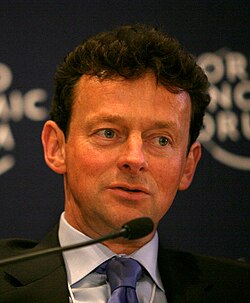 Tony Hayward was named BP CEO in May 2007, replacing Lord Browne of Madingley, who had been severely criticized by both the British and American governments and the public for his mishandling of several serious accidents at BP facilities, the most severe being the 2005 explosion of BP’s Texas City refinery that killed 15 workers and injured about 170 others. Hayward had actually been openly critical of the company’s safety prior to Browne’s departure, and upon assuming his new post told reporters, according to a BBC report at the time, that he intended to be “laser-focused on safety and reliability.”
That didn’t exactly happen, because less than three years later, BP was responsible for the largest accidental oil spill in history, surpassed only by the environmental catastrophe caused by retreating Iraqi troops scuttling Kuwaiti oil wells in the first Gulf War in 1991. And it was Hayward’s demeanor and reactions in the aftermath of the April 2010 Deepwater Horizon disaster in the Gulf of Mexico that set him apart as a true villain in the oil industry.
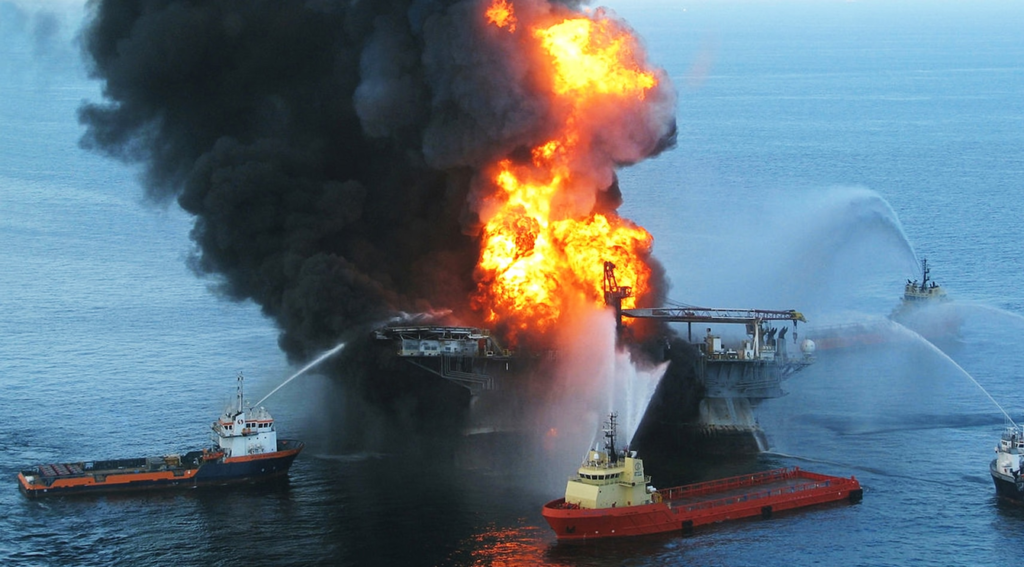
The Deepwater Horizon was a mobile drilling platform leased by BP, working what is called the Macondo Prospect, an oil- and gas-rich tract in the Gulf of Mexico under the exclusive development rights of BP, lying about 40 nautical miles off the coast of Louisiana. Due to pressure from BP to cut costs and speed up the work, it later emerged that a number of important corners had been cut, which resulted in the rig exploding on the evening of April 20, 2010. 11 workers were killed – with a couple of them never being recovered – and 17 others injured, with the burning rig sinking the next day.
That was all bad enough, but the disaster would only get worse. The pipe connecting the deep-sea well the Deepwater Horizon had been drilling broke off during the accident, leaving an open well pipe, some 4,000 feet below the surface, spewing oil and gas at high pressure directly into the water. The broken well would continue to do so until September 19, when it was finally declared sealed, dumping between 4.5 million and 5.4 million barrels of oil into the Gulf of Mexico. The resulting oil spill covered about 182,000 square kilometers of the sea, an area roughly the size of Cambodia, and seriously contaminated about 800 kilometers of coastline stretching from western Florida to Louisiana; pollution eventually reached more than 1,700 kilometers of the US Gulf coast, with oil washing up as far away as Tampa Bay, Florida, and Galveston, Texas.
As BP was directly responsible for the drilling operations of the Deepwater Horizon, responsibility for mitigating the growing environmental disaster and fixing the broken well to stop the flow of oil fell into its lap, and it was in this phase of the catastrophe where Tony Hayward really made a name for himself, and not in a good way. He was excoriated in the US for making public statements downplaying the oil spill – as well as the prodigious use of a toxic oil dispersant called Corexit – saying that the effects would be minimal because “it’s a very big ocean.” BP, as it had been named the “Responsible Party” under the US’ Oil Pollution Act of 1990 on May 18, began restricted access to journalists, a decision that had to have been approved by Hayward.
In early June, with the ongoing spill still far from being solved, Hayward made his most infamous comment, telling reporters, “No one wants this situation to be fixed more than me. You know, I’d like my life back,” which was widely viewed as epitomizing the company’s insensitivity to the environmental and economic havoc being wrought. Later that month, he was publicly dragged by several members of the US House of Representatives for “stonewalling” in his testimony in a hearing about the disaster, and shortly after that, he drew fire for participating in a summer yacht race around the Isle of Wight in England, despite the ongoing crisis.
BP had enough at that point, and in late July 2010 announced that Hayward would be leaving the company, to be replaced by American Bob Dudley, who had been BP’s point man on the oil spill response. The disaster, and Hayward’s poor handling of it, knocked about 40 percent off BP’s market value, dropping from first to fourth in the ranking of the world’s biggest oil companies.
In November 2012, BP agreed to settle charges of “gross negligence and willful misconduct” brought against it by the US Department of Justice, as well 11 criminal manslaughter charges, paying a total of $8.5 billion in fines and restitution; $4.5 billion for the civil charges and $4 billion for the criminal charges. Altogether, the fines, penalties, civil settlement, and cleanup costs from the Deepwater Horizon disaster are estimated to have cost BP more than $65 billion.
Tony Hayward at SierraCol
Hayward’s Colombia-based oil company, SierraCol Energy, seems to have operated without any serious disasters that could be attributed to bad management, but it has been under fire for most of its life for poor environmental performance and bad relations with indigenous and local communities. That is something that seems to be endemic to the Colombian petroleum industry, so it might be unfair to single out SierraCol, but on the other hand, the man who was once “laser-focused on safety and reliability” certainly does not seem to have done much to make his company an outlier in that environment.
In another controversial move, in November 2025 SierraCol made a $600 million bond issue, and then used half of the proceeds to pay dividends. The deal was a repeat of one the company had made in 2021, when the dividends were collected by Carlyle; the 2025 issue bought back and refinanced $300 million of those original bonds maturing in 2028, and replaced them with bonds maturing in 2030. What may be a red flag in this is that by that time, the negotiations for SierraCol’s eventual acquisition by Prime Infra were surely underway, something that was evidently not common knowledge at the time among the several analysts who criticized the deal as risky, if not reckless.
For example, in a LinkedIn post from December 2025 Juan Manuel Patiño, an analyst at Colombia’s SunCapital Valores S.A. commented, “Colombian oil and gas producers remain high-cost, mature operators facing structural and company-specific challenges. Canacol’s output keeps falling, Frontera still struggles with its Pacific Rubiales legacy, and GeoPark faces governance issues. Now SierraCol adds pressure with a $600m bond deal, using half the proceeds for dividends. With such an unusually uncertain oil price outlook heading into 2026, one would have expected greater prudence from management.”
Sand in the Vaseline
About the only way that Prime Infra’s taking Tony Hayward on board makes sense is if doing so was an unavoidable “cost of doing business,” a compromise necessary to get the SierraCol deal done. And in that case, the company certainly couldn’t be candid about it, and would have to do exactly what it has done, which is to issue a sanitized press release about him. Unfortunately, that kind of thing always comes across sounding like, “but look at all the good things Hitler did,” and ends up making the company look foolish.
Tony Hayward shouldn’t be anywhere near an oil and gas business, let alone managing or having a hand in governance decisions for one. SierraCol Energy sounds like a risky venture even without him being part of the equation, since Prime Infra is going to inherit its dubious ESG record and the scrutiny that comes with it. Giving the guy who oversaw what may have been the biggest ESG failure in history a job is certainly not going to make that any easier. Good luck to Prime Infra’s corporate comms people; you’re going to need it.