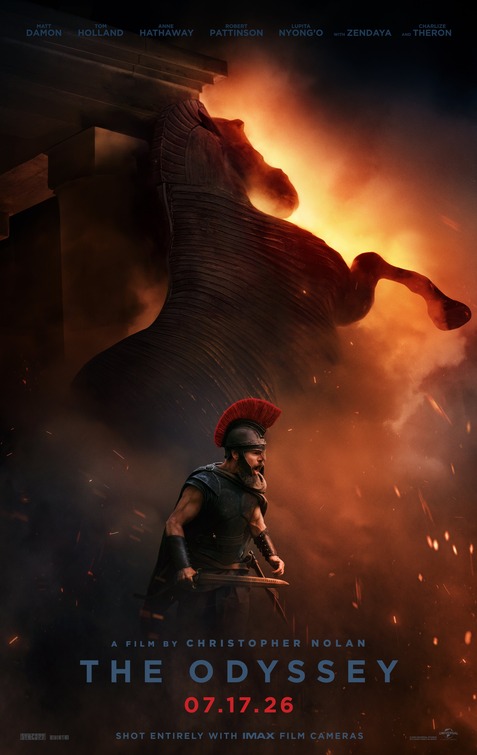
OKAY, I’m not a clickbait merchant, and movie reviews – the same could be said of online recipes, now that I think about it – that back into the main point of the post after several paragraphs of drivel designed to keep you on the page piss me off to no end, so I’m not going to do that. So here’s the verdict: Christopher Nolan’s The Odyssey was fucking fantastic, and I would give it not two, but three thumbs up. Or six stars instead of five. Run, don’t walk, to see it in a theater immediately, and you will be glad you did.
So there. If that is all you need to know, there you go. Thank you for dropping by, and feel free to move on to whatever it is you do online. For those who may be interested in how I reached that conclusion, and are not put off by someone who is about to go full history and literature nerd on a topic, read on.
I saw the movie Saturday afternoon, it is Sunday evening as I write this, and I’ve spent a significant fraction of the past 24 hours mulling this over, skimming through the original The Odyssey, which I haven’t read in full since high school, and reading various scholarly interpretations of both the original literature and the film, as well as brushing up on Greek mythology, which is something I was rabid about when I was in sixth or seventh grade. “Reimagining” – I hate that word, and it should be banned from the English language, maybe I should message Bill Nighy about it – or creatively interpreting classical literature has been done since humans figured out what that was, but it is a tricky proposition, and not something that always goes well, particularly when the source material is something that is already very familiar.
Shakespeare is the ultimate example of this. There have been countless stage and screen adaptations of his plays, and their success, at least in the modern era – either commercially, or at least in being recognized as good pieces of art – has been about 50-50. For example, Richard Loncraine’s 1995 adaptation of Richard III (starring Ian McKellen) and Baz Luhrmann’s 1996 “reimagining” of Romeo and Juliet (starring Leonardo Dicaprio and Clair Danes) were fantastic. On the other hand, David Michôd’s 2019 adaptation of Henry V (entitled The King), and the 1990 film version of Hamlet starring Mel Gibson – despite being directed by Franco Zefferelli – were pretty weak.
Shakespeare, however, pales in comparison to the brutal complexity of something like The Odyssey. Even if his output had completely sucked, I would have still given Christopher Nolan a little credit for making the attempt.
And his output most definitely did not suck.
The (real) story
To appreciate this, you have to understand at least a little bit about the source material. The Odyssey, as far as scholars who have studied it for literally millennia have been able to determine, was written down sometime during the 8th century BCE (so roughly 2,800 to 2,900 years ago), and is generally attributed to the Classical Greek poet Homer, although there is some debate about whether he actually wrote all or any of it. The story is thought to be much older, dating back to perhaps the late Bronze Age (about 1200-1300 BCE), and was almost certainly an oral tale, meant to be performed by an aoidos or rhapsode, rather than read. Part of what dates the story as far older than its written form is that it has a great deal in common with Epic of Gilgamesh, the oldest parts of which were composed as far back as 2100 BCE. Thus, Homer, or Homer and some other people, or not Homer at all, and just people who had a similar style, more or less simply committed to writing a very old tale that had existed as an oral tradition for at least a few centuries.
The basic story is about the epic, 10-year-long journey of Odysseus (Ulysses in the Latin form), king of Ithaca and hero of the Trojan War, as it was he who devised the Trojan Horse, home from the end of the war, which had already taken 10 years. Along the way, Odysseus faces many tribulations, delays, and fantastic challenges, gradually loses all his men, and finally reaches home alone, 20 years after he departed. He finds his faithful wife and queen Penelope and his son Telemachus, who has grown from an infant to a worthy heir in his absence, pestered by dozens of suitors eager for power in the assumption that Odysseus has died.
Odysseus, along with his son and a few faithful servants, reveals himself and kills them all, and when their families come seeking revenge, the intercession of the goddess Athena stops them, as Odysseus has learned his lesson and cleansed his soul. The story ends with Odysseus and Penelope, happily reunited as husband and wife, sailing off into the sunset so that Odysseus can fulfill his vow to honor the men he lost at Troy and during his epic journey home, leaving his son Telemachus to assume his rightful place as king in Ithaca.
The original is by no means linear, and it is technically challenge to read, even in its expertly translated forms. It is, as I said, a poem, but one that is approximately 120,000 words long, and written in dactylic hexameter, which is a form that sounds good if someone is reciting it, but can be a real bastard to read. And of course, the original was written in Homeric Greek, which was not a form of the language that anyone spoke (as far as we know), but was a form for written literature, so the original is itself a translation; the subsequent translations into Latin, French, English, or whatever language simply added extra levels of difficult.
Making the adaptation work
The Odyssey is essentially a lesson in morality – that was Homer’s point. It is a story about guilt, redemption, loyalty, and perseverance in the face of challenges and temptations to “take the easy way out.” This is the aspect of the story that Christopher Nolan absolutely nailed, and it is what make the movie a fantastic adaptation, even though it necessarily diverges from the convoluted narrative of the original.
In this respect, The Odyssey has much in common with Nolan’s other recent profound cinematic success, Oppenheimer, something that Matt Damon (who stars here as Odysseus, and played a key supporting role in Oppenheimer as General Leslie Groves) apparently picked up on right away when he read the script, according to some published interviews. In both the hero is a brilliant but flawed human who devises a weapon of immense destructive power (the Trojan Horse in Odysseus’ case, the atomic bomb in Oppenheimer’s), to solve an intractable conflict – the 10-years-and-counting siege of Troy, and the insane war against Japan that might not have otherwise ended without the extermination of the Japanese civilization. But each is wracked by guilt by what he has done, because each senses that it has fundamentally changed the world for the worse. And each has to be put through the wringer until he fully understands it, and is able to come to terms with it. In Odysseus’ case, he was put through a ten-year epic journey of hardship, in which he was repeatedly forced to make hard choices for the sake of the greater goal, and was rewarded by being able to see his home one last time, being reunited with his family, and being able to reestablish peace and order in his kingdom. In Oppenheimer’s case, he was vindicated – months from the end of his life – as one of America’s greatest scientists and a voice for reason and peace.
Writing that paragraph gave me an LSS moment. In the words of the immortal Steve Miller, “You know you got to go through Hell before you get to Heaven.”
The nitpicky stuff
First of all, let’s address the racist, fascist anger at the “woke” character of the movie – because it has people in it who are Not White – as most loudly shouted by utter retard and complete waste of three-dimensional space Elon Musk; seriously, just overdose on ketamine and choke to death on your own vomit already, you disgusting piece of shit.
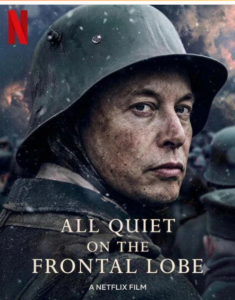 Elon is apparently upset that there are non-white characters in the film, namely, Helen of Troy and her twin sister Clytemnestra, played by the wonderful (and if I may say so without offending my girlfriend, very attractive) Lupita Nyong’o, who is very black, and Athena, who is played by Zendaya (whose mate Tom Holland expertly plays Odysseus’ son Telemachus), who is…whatever she is. Not white, but who should even care about that shit, she’s a person. In addition, some of Odysseus’ companions in the film, as well as other characters, are not of the Caucasian persuasion, and that apparently offends the sensitivities of people whose vision of gods and heroes stops at people who look like they grew up in Salt Lake City.
Anyway, apparently Elon was so offended that he announced that he would direct his Grok AI – which, in my opinion, is the stupidest of the various ‘big AI’ platforms currently available – to redo the movie to be “historically accurate” and “faithful to Homer’s original.”
Yeah, good luck with that, jackass. For one thing, the notion of “historical accuracy” is completely laughable, because none of anything that is in The Odyssey ever happened, and even Homer (or whoever wrote it) 29 centuries ago acknowledged that, if only indirectly. The moral lesson was the point, not the “historical accuracy” of the tale. Second, a “faithful to Homer’s original” treatment would likely result in a movie 18 hours long that no one could understand.
Christopher Nolan’s treatment of The Odyssey works because he did understand the essential lessons about humanity that Homer was trying to impart, and translated them into a script and a film. As it is, the film pushes the limits as far as runtime – it’s close to three hours, which is at the limit of being able to engage someone’s attention without losing them to more than one bathroom visit.
In order to do that, Nolan had to cut some things from the original tale, and for pedants this might be bothersome. The chronology of The Odyssey is shortened up quite a bit and rearranged to some extent, and while I understand why that was so in order to produce a digestible movie, there were still some aspects of it that bothered me a bit. In addition, there were one or two casting choices that I think could have been better in the context of the overall message Nolan was trying to deliver.
After having thought about this for a while, I can narrow it down to four specific complaints I might make about the story – not the film overall, which is the state of the art as far as I am concerned in terms of the acting, the cinematography, the music, and the pacing – but the story itself. Making allowances for the difficulty in distilling Homer’s work into a watchable film, these are the things that bothered me, albeit not enough to diminish the esteem with which I hold the work:
A couple of important things got left out: In the original, Odysseus and his companions land in the realm of the Lotus Eaters, and eating the lotuses causes them all to forget their wishes to return home. In the movie, the lotus thing is combined with Odysseus’ seven-year sojourn with Calypso (played by Charlize Theron), so the same idea is kind of imparted, but in the original it was much more significant.
In addition, in the original, Odysseus and his crew encounter the God of Winds (Aeolus), who gives them a bag as a gift, but with the proviso that they do not open it until they reach home. They almost do reach home, but the greedy crew, thinking it might contain some treasure, opens it, which releases winds that blow them off course for another few years. This would have been a good parable to work into the script, in my opinion.
A little bit of miscasting: Don’t get me wrong, everyone in the movie did a wonderful job; for those who are students of theater and acting, this was a masterclass. However, if it had been up to me, I may have made a few different choices, out of respect to the source material.
Matt Damon as Odysseus was awesome, as was Tom Holland as Telemachus, Anne Hathaway as Penelope, Lupita Nyong’o in her (relatively brief) twin role, John Leguizamo as Eumaeus, and Robert Pattinson as Antinous. However, there were two that bothered me a bit, and that was Zendaya as Athena, and Charlize Theron as Calypso.
In the original, Athena is a much more aggressive and involved character than is portrayed in the movie, including the goddess sometimes disguising herself as men. Zendaya’s character here is more an unseen muse, and I think it might have worked better if the character was written to be more engaged, which Zendaya probably could’ve pulled off if she had the chance. The Calypso character, however, was totally wrong. In the original, Calypso is clingy and manipulative, which is why Odysseus ends up stuck with her for seven years as her captive ‘husband.’ Charlize Theron has never come across that way in any of her roles, and she certainly does not here, so if I had been in charge of casting, I might have made a different choice.
However, I would like to reiterate that everyone involved in this movie did a fantastic job with the role and script they were given to work with. There may have been a few different choices that could have been made, but what we got was stunning. As far as I’m concerned, The Odyssey is the best movie of the year, and judging from the mindless twaddle that’s in the pipeline, it looks to me like it won’t be dethroned. If it doesn’t win all the awards at the end of the season, I personally will consider that a travesty of justice, and further evidence of man’s ignorance.