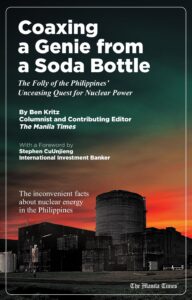
 THIS is going to be a relatively brief post, because I have already damned near made an entirely new career writing on this topic. Enough, in fact, that my output produced a book, “Coaxing a Genie from a Soda Bottle,” which is collection of my Manila Times columns on the topic of nuclear energy and the Philippines’ unrealistic fascination with it, spanning the years 2015 to early 2024. I have written a great deal since then, and it is very possible, likely in fact, that within a relatively short period of time I will have accumulated enough material for a Volume 2.
A couple of notes, in the interest of transparency, I suppose. Although it was published in 2024, the book hasn’t really seen the light of day apart from the couple of dozen e-copies I shared with some people. This wasn’t a case of my publisher (i.e. my employer) trying to quash it, I just think our marketing people didn’t know what to do with it. That annoyed me greatly in the first weeks and months after its publication, but the world keeps turning, and there are always other things to do.
As far as the subject matter, it is still a very live topic here in the Philippines, and has gotten some more attention in recent weeks as a result of the war in the Middle East and its impact on energy security. For those looking for a TL:DR summary of what I think – and what I think is backed up by sound economics and science – here it is: Small modular reactors are a stupid idea, and nothing more than a form of venture-capital pump-and-dump. I am not a “never nuclear” person, although I used to be, but I strongly believe (and can prove it) that the economics that can make it practical are exceedingly narrow. As far as SMRs go, I do believe they have a very good chance of being productively applied in shipping, if the advocates of SMRs were at all serious about the technology, which they are not; otherwise, they are a waste of time and money. As “cleaner” power for on-land electricity generation, nuclear plants need to be big, and they need to be underwritten by the government. That’s not the direction policymakers, at least the ones here in the Philippines are headed, so we have a problem.
The e-book is available in either PDF or e-pub file formats, for the price of $4.99 (or P300). I can accept PayPal, Maya (if you’re in the Philippines), or bank transfer; drop me a line in the message box or in a comment for this post, and I will be happy to take care of it.