This was my Manila Times column from Sunday, February 15, 2026, which I mentioned in my last post. I didn’t really get much in the way of direct feedback about it, although I learned from one of the extensive network of moles I have throughout the government here that the Dept. of Tourism was rather annoyed by it. However, the department was said to be reluctant to respond to it publicly, as that would invite a nasty follow-up on my part, and the last time they went head-to-head with me, they lost. That particular instance, a couple of years ago, was my calling out the Tourism Investment and Ecozone Authority (TIEZA) for blocking completion of a major electricity grid connection project, because there was a section of the line that crossed a property — in the middle of nowhere in Cebu Province — where TIEZA wanted to build a golf course. So yeah, you tourism people probably don’t want to try me.
Tourism is fascinating to me, from an economic perspective. It is what we call a “tradeable” sector, because it essentially functions in the economy the same way exports do. However, it is extremely sensitive to product lifecycle, and cannot be sustained in its original form indefinitely. The tourism policymakers in this country have never understood that, and because they don’t, they are making that lifecycle much shorter than it could be. The place that is the subject of this column is a stark, and rather sad example of this.
***
DURING my recent extended weekend vacation to Panglao, Bohol, I took the opportunity afforded by bright, clear weather the day after the passage of Tropical Storm Basyang to visit the Alona Beach area, which is probably the best-known tourist destination on the island. It has been slightly less than three years since I vacationed at Alona Beach, and I enjoyed it then, finding it to be a nice mix of natural beach features and activities and entertainment.
Evidently, a lot can change in three years. Alona Beach has quickly transformed from an exemplary Philippine tourism destination to an absolute dump – recklessly overdeveloped, overcrowded, overpriced, and worst of all, the beach itself has been virtually destroyed. And I mean that literally; it is disappearing. Not that anyone would want to spend much time on it, anyway, as the water is turbid and badly clogged with thick algae, an indication of the presence of a significant amount of organic pollutants. The entire area has taken on a dusty, unkempt appearance, with the only part of it that is not is the section on the eastern end where the large Henann Beach Resort is located; but even that part of the beach is not spared from the general nastiness of the water.
Even the area away from the beach, along the Alona Beach Road that connects the beach area to the main highway, appears worn-down. “Tired” is the word that immediately came to mind, as if the entire area has collectively decided it is just too exhausted by the constant frenzy of crowds and commercial activity to put forth the effort to fix a broken sign, freshen up a dull paint job, or pick up the trash. Not every individual establishment is like that, of course, but the prevailing atmosphere is one of unpleasant weariness.
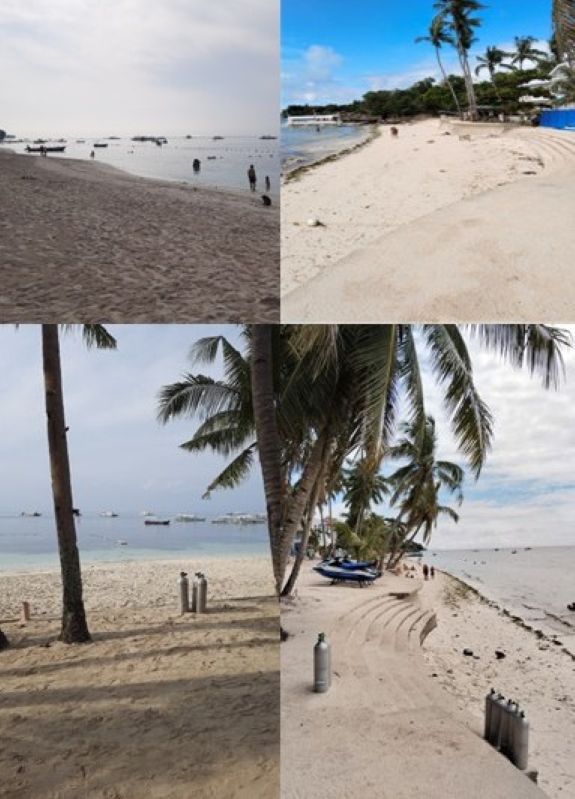
Concerning the deterioration of the beach itself, which is perhaps the most shocking aspect of Alona Beach’s transformation, the culprit is immediately obvious. A large seawall is being constructed along most of the beach’s length, which has narrowed both the beach and the beachfront lane where pedestrians, street vendors, and vehicles such as delivery trucks all compete for space. The picture below is a composite of photos I took in April 2023 (left) and on Saturday, Feb. 7 (right), in approximately the same locations (top and bottom), and it shows how much of the beach has been erased by the seawall construction. Within a couple of years, unless some other remediation is done, there will very likely be no beach at all in front of the seawall.
That seawall is clearly intended to protect the commercial infrastructure behind the beach, and in the respect is emblematic of the entire wrong-headed policy approach to tourism in this country. In the government’s doggedly blindered – some might say desperate – pursuit of constant growth in tourism revenues and visitor numbers, it too often sacrifices the resources that make areas tourist destinations in the first place. It has happened at Boracay, it has happened at El Nido, and it is clearly happening quickly at this once-wonderful part of Panglao. If you talk to foreign visitors, it is becoming increasingly common to hear much the same lament about other places such as Siargao, and Port Barton, Palawan.
The irony, perhaps, is that most big tourism developers are actually doing it right with the extensive resort properties they have built, and are continuing to build at an energetic pace. They preserve the key natural features (such as the beach) that are the foundation of their being marketable tourist destinations, and exercise planning control over ancillary development, either by buying up the nearby land and doing it themselves, or through mere local economic dominance. By virtue of having a finite number of accommodations for visitors, they also naturally control the visitor load on locations.
Obviously, this is not ideal. In a country with such enormous tourism potential, and where more than 90 percent of business establishments are MSMEs, the idea of shutting them out in favor of a relative few big corporate interests is not only morally reprehensible, it is ultimately economically counterproductive. And big-box, resort-based vacations are not within everyone’s means, nor to everyone’s taste.
Be that as it may, there is no reason that the country’s tourism policy cannot adopt the principles that make those places work, and work sustainably with a 25- or 30- or 50-year productive horizon in mind. That means prioritizing the tourism assets first and foremost – the beaches, the natural areas, the historic and cultural sights, and then prioritizing people.
The people of tourism communities are the real tourism infrastructure, not dumb artifices like “tourism rest areas.” Whether visitors are coming from the other side of the country or the other side of the world, they are coming to experience the authenticity of a place that is new and different, so give those places the tools they need to be themselves – stable electricity and water supplies, good internet connectivity, paved roads, and supply chain infrastructure that supports their fisheries, or agriculture, or local small industries.
And yes, that certainly will require a sacrifice of national tourism policy’s aspirations for growth-at-any-cost, short-term revenue gains, and image cultivation. In fact, it may mean sacrificing the concept of national tourism policy and governance altogether. After all, it can hardly be argued that the current framework is meeting expectations, and when that becomes a consistent pattern year after year, the solution almost never is, “do the same thing, but just do it harder.”