 My column in The Manila Times on Sunday, January 25.
***
THIS past week, the world marked a depressing anniversary, that being the first full year in office for Donald Trump in his second term. Everyone already knows what I think of that…entity, and I am not going rehash his manifold flaws, or his neo-Nazi domestic reign of terror, or his ludicrous and embarrassing antics on the world stage. Instead, my historian side is going to appreciate this opportunity to reflect on this discomfiting interval of contemporary history in a broader context.
It’s still not going to be very encouraging; in fact, it’s even more disheartening than “the US is being led by a perverse, feeble-minded sociopath.” But it is fascinating, because the result of the past year is something unprecedented in history.
For 80 years, or since the end of World War 2, the world has lived under an American-led global order that has structured world affairs. For eight decades, a largely liberal international order has been shaped by America’s predominant economic, military, and cultural strength. Indeed, there have been challengers and rivals, but they have been constrained by the combined wealth and might of the US and its allies, which have always dwarfed the Soviet/Russian or Chinese blocs in number. Global trade has been generally free and unhindered by geopolitical rivalries, the oceans and skies have been safe for travel, and nuclear weapons have been limited by agreements on their production and use; and even before that was the case, American technical superiority in that regard – we did invent the damned things, after all – and the principle of Mutually Assured Destruction (MAD) kept things in check.
That was true up until January 20, 2025 (or the 21st, here in Manila). On January 21, it no longer was. And that is the remarkable historical aspect to all of this. Empires have come and gone. Some have collapsed under their own weight of internal stresses, or have been broken down bit by bit by outside enemies, or both. But none have ever, in the words of historian Jonathan V. Last (one of the several respected authors I read in preparation for this piece), “renounced their leadership of the world – all at once, and in full public view.”
From personal observation, I can peg the exact moment it happened. My partner and I – who works in development finance – had just arrived for a much-needed vacation in Palawan on January 22 of last year. We had a few hours’ peace, but on the morning of the 23rd, both of our phones started exploding, after the news that the US had instantly ended almost all of its foreign aid, including dissolving the US Agency for International Development (USAID).
Trump himself does not understand that America has abdicated its leadership of the free world, with his claims to having “ended eight wars,” and long, incoherent speeches before, for example, the UN General Assembly, and earlier this week, the world leaders assembled at the World Economic Forum in Davos, Switzerland, in which he scolded the rest of the world with petty complaints.
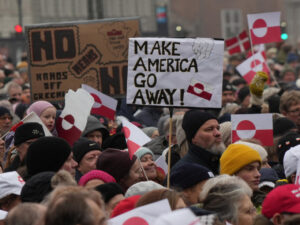
But Trump, for as much attention as he gets, is an avatar. This is not “a Trump problem” for the rest of the world, but “an America problem.” That he got elected and has lasted even a year into his second term, after having been a complete disaster in his first stint in office, indicates that he adequately represents the will of America. Yes, there is loud opposition to Trump and the regime he putatively leads, but Horseshoe Theory tells us that is less meaningful, and less likely to result in something different than we may suppose. That’s a long discussion, so look it up if you’re curious.
So what happens next? Various sages such as the aforementioned Mr. Last have suggested particular outcomes we will see in the near future, such as the collapse of the North Atlantic Treaty Organization (NATO) and the end of the “Five Eyes” intelligence network among the world’s major English-speaking countries; Greenland becoming disputed territory (everyone regards the hints about a “deal” coming out of the Davos meetings as short-lived, at best); a return to the nuclear arms race; closer ties between Europe and China, despite their vast differences; and Ukraine being drawn firmly into the Western European sphere.
All or none of those things may come to pass, but they are details. As I said at the outset, the big picture is the interesting one, and it is a picture of a world that almost nobody alive today has lived in. Historian Robert Kagan suggests it will look much like the world prior to 1945, “with multiple great powers and metastasizing competition and conflicts.”
The real powers behind Trump, the well-organized conservative, Christofascist political core (i.e., the brains behind the sinister “Project 2025” and their followers) and the techno-oligarchs, did this on purpose because they believe that the new world order can be managed by America so that America can still enjoy most of the benefits of the post-1945 era. The favorite example among the Trump-backing “foreign policy elite,” as Kagan observes, is the so-called “Great Concert,” or “Century of Peace” in Europe (because of course, whatever happened in the non-white parts of the world at that time is completely irrelevant) between the end of the Napoleonic Wars and the beginning of the First World War (1815-1914). This view holds that diplomacy among many “great powers” can maintain the peace to the benefit of all, without the burden to America of the American-led global order of the last 80 years.
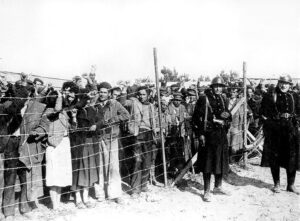 As Kagan and other historians note, this is madness. The century between the end of the Napoleonic Age and World War 1 was one of the bloodiest in history for the European powers, and even more so for the colonial subjects in Asia, Africa, and South America they competed over. There was no decade during that period in which there was not at least one or two wars involving the great powers of the time, fighting over strategic advantage, economic and political spheres of influence, and natural resources. Jonathan V. Last provides a couple of examples; a half million dead during the Crimean War (1853-1856), and about 430,000 combined military and civilian deaths in less than a year in the Franco-Prussian War of 1870-1871. We could also include other conflagrations such as millions dead in British wars in India, China, and South Africa during the period; two million or more in a string of wars among the newly-liberated former Spanish and Portuguese colonies in South America; and America’s own, half-century long bloodbath through wars with Mexico, its own Civil War, its genocidal campaign against the Native Americans, the Spanish-American War, and the Philippine War.
We are not ready to live in this kind of world, but we will need to learn how. And it is not going to go well for many of us. I’m old enough that I can take comfort in the likelihood that I will not live to see the next world war or similar catastrophe that will change the world again, but I worry for my children, and the younger generations. I hope that they can do a better job than we have.