
 I liked it.
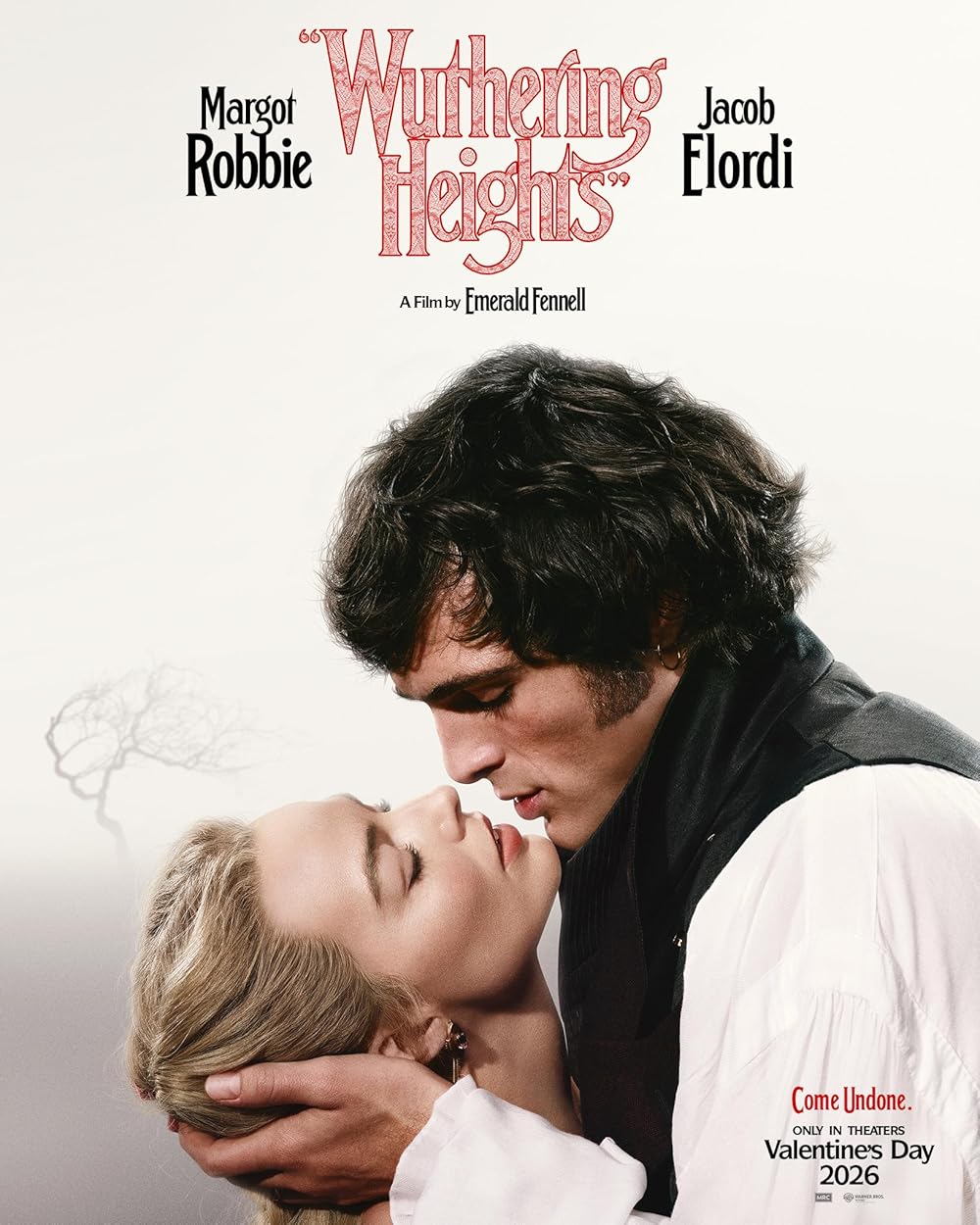
Let’s clear this up right off the bat: The movie is not anywhere even close to being an adaptation of Emily Brontë’s 1847 novel (her only one, she died of tuberculosis at the age of 30, two years after the book was published). Director Emerald Fennell tagged the movie as “based on” the novel, and even went so far as to put the title in quotation marks, which was something I didn’t notice at first until I read a BBC review about it. There have been several film and TV adaptations that tried to follow the book more faithfully, with mixed success, because it is one of the most complex and non-linear of the great gothic novels of the early Victorian era.
Oh, and by the way, I’m not going to sit here and write “spoiler alert” every time I drop a key point. I hate that shit. Manage your own bandwidth.
The big differences between the novel and this movie are that the story is told in POV-style (in the novel it’s a narration by several characters); the entire second half of the novel is omitted; and key characters, such as Catherine’s and Heathcliff’s children, are also left out. Critics have also dumped on Fennell’s casting choices, as some of them do not match appearances with their novel counterparts. Catherine Earnshaw (played by Margot Robbie) certainly fits the brief, but her maid and confidante Nelly, who is portrayed by Vietnamese-American actress Hong Chau, is definitely not Asian in the book; given the time period the novel is set in, and even the time period in which Brontë wrote it, it is unlikely it would have ever crossed her mind to make her Asian. Nelly in the movie is also apparently significantly older than Catherine; it is a bit jangly, because in the very beginning of the movie they are the same age or nearly so, as in the novel, but that changes later. Ms. Chau, however, nails the character, gradually progressing from being a sympathetic, sensible sidekick to being an utterly detestable schemer.
Heathcliff is played by Australian actor Jacob Elordi, who also does an excellent job with the character but is definitely quite a bit less ‘ethnic’ than the character in the novel, who is of uncertain South Asian or Gypsy descent. On the other hand, the novel’s typically pasty-faced Englishman Edgar Linton is portrayed by Pakistani actor Shazad Latif, who comes across as significantly less toxic than he is in the book, although not so much as to make the character unrecognizable.
Since they did such a good job of capturing the essence of their respective characters, the ethnicity of the actors seems to me a petty complaint; it in no way has any impact on the story, or their interactions. But I suppose that those who find it off-putting are probably also the same people who would be bothered by the movie being derivative rather than an adaptation, and if that’s the impression they have, so be it. Or they might just be closet racists; you can’t tell with people anymore.
Even though the plot of the novel is truncated and significantly modified, if you understand going in that is the case, then what makes the movie great it succeeds in faithfully preserving the real essence of Brontë’s novel, which is an indictment of the venal bleakness of supposedly civilized society. These people are frankly terrible – depraved and emotionally unhinged, selfish, petty, vindictive, and cruel. It is weird that the movie was released on Valentine’s Day and branded as a love story, because it isn’t. If it’s anything, it’s a bitter commentary on obsession. People make the same mistake in positioning the novel as a love story, too, but that was not Brontë’s intent – otherwise, she would not have picked the bleakest, most depressing landscape in all of England (the Yorkshire Moors) as its setting.
As far as that goes, Fennell nailed it; the cinematography is beautiful, and visually, the movie looks exactly like the picture Brontë’s words on paper put into one’s head. Or at least mine, anyway; your results may vary. I read a complaint from some pedantic dipshit in one review that the costumes were not “period accurate,” but that is flat wrong. Even though the novel was published in 1847, it is set – or rather, the first part of the story covered by this movie is – in the late Georgian period, the latter half of the 18th century (specifically, from about 1770 to 1783, which is the year the adult Heathcliff returns to Wuthering Heights in the novel). So in that respect, the costumes and sets were dead-on.
I would rate “Wuthering Heights” (I still find the quotation marks weird) probably four out of five stars; Emerald Fennell and the cast do an excellent job with a challenging concept, and the movie is a welcome nugget of class, depth, and creativity in the slagpile of money-grabbing brainrot the movie landscape has otherwise become. I would like to see it again in the cinema if I have the chance; unfortunately, movies that do not insult one’s intelligence tend not to run very long here in the Philippines (they’re all about the brainrot), so I may end up waiting for it to hit streaming.